
February represented an important milestone in the CODING&CO-DOING project, with three teacher training sessions led by the University of Bologna and involving educators from Italy and Luxembourg. Held on February 5th, 12th and 24th, the meetings were conceived as different stages of the same learning journey. Starting from an initial reflection on the meaning of coding in early childhood education, teachers gradually explored its relationship with creativity, collaboration and inclusion, before moving towards the design of concrete educational experiences for nurseries and preschools. Rather than focusing exclusively on technological tools, the training encouraged participants to look at coding from a broader pedagogical perspective. What does it mean to introduce coding to very young children? What competences can it support? How can coding activities leave space for creativity rather than simply asking children to follow instructions? And how can teachers design experiences that promote not only individual problem solving, but also cooperation and shared learning? These questions accompanied Italian and Luxembourgish teachers throughout the three sessions and created the foundations for a common reflection on the role that coding can play in contemporary early childhood education.
February 5 – Discovering coding as a mindset
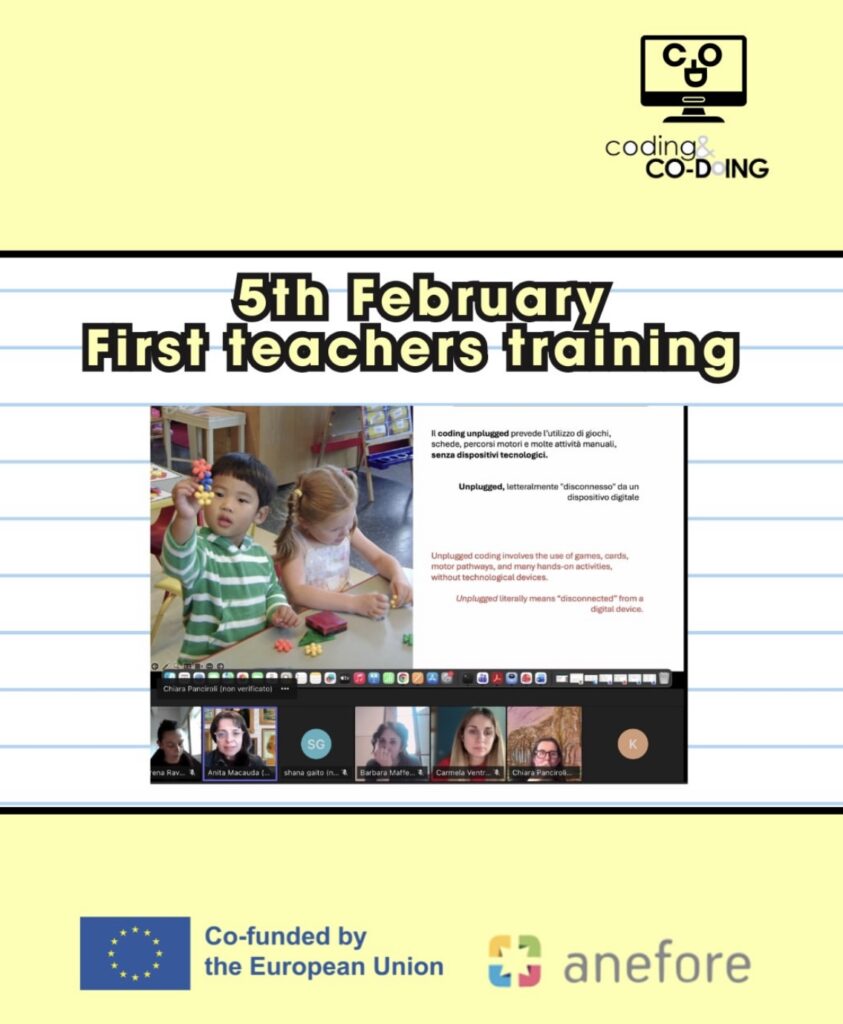
The first teacher training session took place on February 5th and represented the starting point of this shared journey.
The meeting offered participants an initial introduction to coding in early childhood education, moving beyond the idea that coding necessarily means programming a computer or using digital devices.
Instead, coding was presented as a way of thinking and approaching problems: observing a situation, identifying possible steps, creating sequences, testing solutions, recognising mistakes and trying again.
From this perspective, coding can support several competences that are already central to early childhood education, including logical thinking, creativity, problem solving, collaboration and learning through play.
Through a group activity and the analysis of different educational experiences, teachers were invited to critically reflect on the potential and limitations of different coding activities. An important part of the discussion focused on the difference between activities in which children simply execute predefined instructions and experiences that allow them to make decisions, explore possibilities and construct their own solutions. This distinction led participants to identify some key pedagogical principles for meaningful coding activities: creating more inclusive and creative experiences, proposing open-ended tasks, encouraging peer interaction and collaboration, and giving children sufficient autonomy during the learning process. The teacher’s role also emerged as particularly important. Rather than providing the “correct” solution, educators can create the conditions for exploration, observe children’s strategies, ask questions and help them reflect on the processes they are experiencing. The group work generated considerable interest and opened several questions for further exploration: What does creative coding really mean? How can we foster creativity through coding activities? How can we move from individual tasks towards collaborative experiences that support both social and cognitive cooperation? Instead of immediately providing definitive answers, these questions became the starting point for the following stages of the training.
February 12 – Coding as a creative mindset
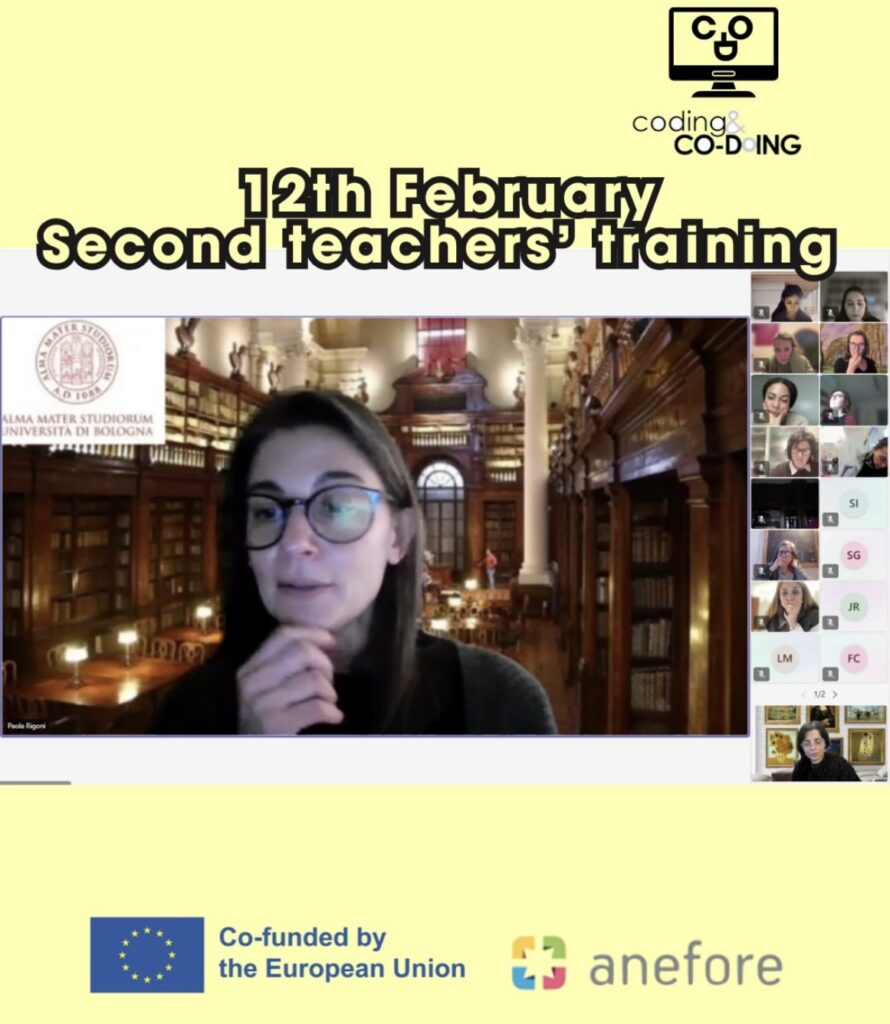
The second meeting, held on February 12th, developed one of the key themes that had emerged during the first session: creativity.
If coding involves sequences, rules and instructions, where does creativity enter the process? And what needs to happen for a coding activity to become a genuinely creative educational experience?
Participants explored creativity not simply as the production of something original, but as a way of thinking that involves experimentation, transformation and the ability to move beyond established routines.
The session reflected on how creative thinking can emerge through non-standard uses of language and thought, heuristic problem solving, the inhibition of automatic responses and analogical thinking. From this perspective, coding can become creative when children are not only asked to reproduce a predetermined sequence but are given opportunities to imagine alternatives, change rules, combine ideas and find different ways to reach a goal. Drawing on Seymour Papert’s educational legacy and references from the arts, the training invited teachers to consider coding as an environment in which children can become active creators rather than passive users of technology. An additional framework introduced during the session was the “3B model” of creativity: bending, breaking and blending. Bending involves transforming or adapting something that already exists. Breaking means challenging established rules, routines or patterns. Blending involves combining elements from different areas to generate new possibilities. Applied to early childhood education, these three dimensions offer an interesting way to rethink coding activities. A sequence can be changed, a rule can be questioned, a story can be connected to movement, a robot can become part of an artistic activity, and technology can interact with music, space, language or imaginative play. The idea of blending different domains was particularly relevant to the preschool context, where learning is naturally interdisciplinary and children often explore the world through multiple languages and forms of expression. In the final part of the meeting, teachers moved from theoretical reflection to practical experimentation. Working in small groups, participants designed micro-teaching activities that combined unplugged and plugged phases. They were encouraged to connect coding with specific fields of experience in early childhood education and to reflect on how educational robotics could support meaningful and creative learning. This design activity helped teachers begin translating pedagogical principles into concrete educational proposals while also considering the balance between technology, physical experience, interaction and play.
February 24 – Designing coding experiences
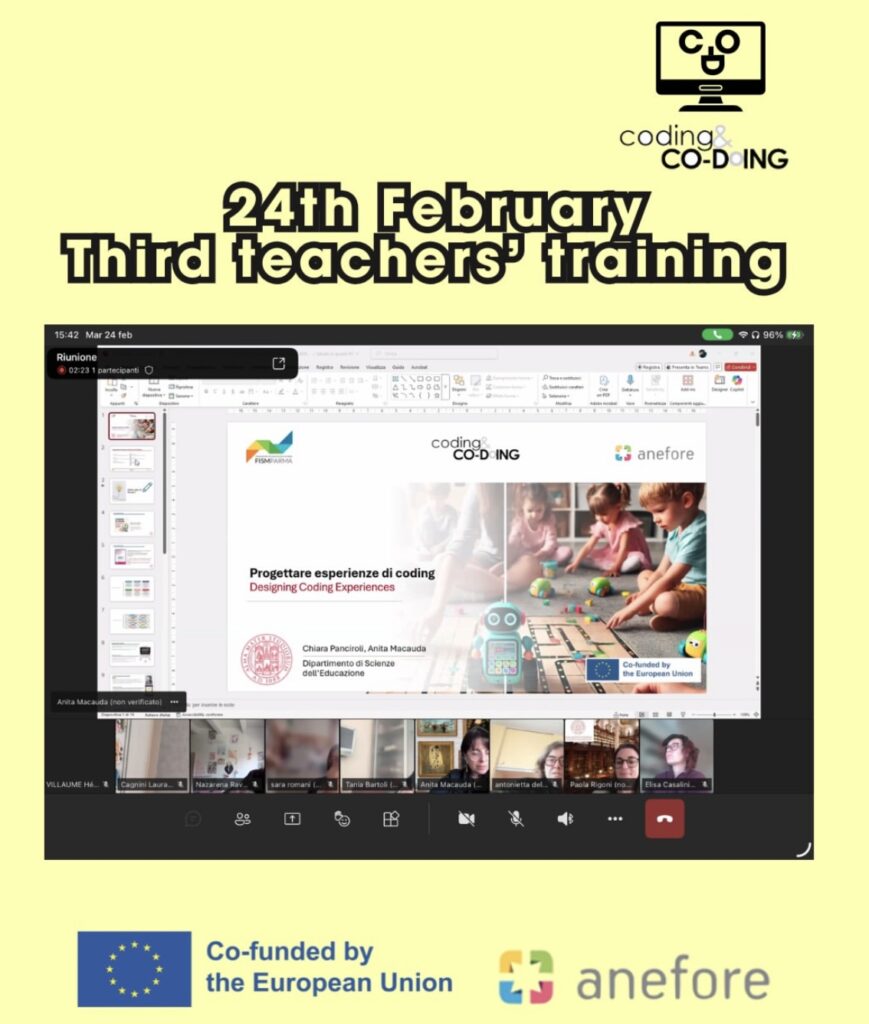
The third training meeting, held on February 24th, represented a further step in the process: moving from exploration and reflection towards educational design.
Teachers briefly presented and shared the creative coding activities they had developed, providing an opportunity to compare different approaches and discuss how coding could be adapted to different educational contexts.
The activities highlighted the richness of combining unplugged and plugged experiences.
Coding does not have to begin with a screen or an educational robot. For young children, computational thinking can emerge through the body, movement, sound, rhythm, spatial exploration, storytelling and interaction with others.
A child following or creating a sequence of movements, for example, is already engaging with concepts that are relevant to computational thinking. The same can happen when children recognise and reproduce rhythmic patterns, give directions to a classmate, organise actions in a specific order or predict what will happen after a particular instruction. Technology can then be introduced as another language within this learning process. Educational robots and digital tools can make cause-and-effect relationships visible, allow children to test their hypotheses and create immediate feedback. However, the discussions throughout the training reinforced the idea that technology should remain a means rather than the educational objective. The quality of a coding experience depends primarily on how it is designed, the questions it generates and the opportunities it creates for children to think, communicate, experiment and collaborate.
Intentionality and flexibility in educational design
One of the key themes emerging from the third meeting was the relationship between intentionality and flexibility.Meaningful coding activities require thoughtful educational planning. Teachers need to consider what children might explore, which competences an activity can support, what materials or tools are appropriate and how the experience relates to the broader educational context. At the same time, planning cannot mean controlling every step of the activity. Children may find unexpected solutions, interpret instructions differently, change the rules of a game or use materials in ways that adults had not anticipated. These moments should not necessarily be considered deviations from the activity. They can become valuable opportunities for observation and learning. A flexible educational design therefore allows teachers to maintain clear pedagogical intentions while remaining open to children’s ideas, questions and discoveries. This perspective also reinforces children’s autonomy and active participation, recognising them as protagonists of the learning process.
Teachers as learners, designers and facilitators
The three training sessions also highlighted the importance of the teacher’s role. Introducing innovative educational methodologies does not mean that teachers need to become programmers or technology specialists. Instead, they need opportunities to understand the pedagogical principles behind coding, experiment with activities themselves and critically evaluate when and why a particular tool can enrich children’s learning. Teachers therefore become learners, designers, observers and facilitators. They design environments and experiences, but they also observe how children respond to them. They provide support without replacing children’s thinking. They adapt activities according to the characteristics of the group and reconsider their choices based on what happens during practice. Professional development is particularly valuable when it creates opportunities for this kind of reflection and exchange. By bringing together educators from Italy and Luxembourg, the February training programme created a space in which different experiences, educational cultures and perspectives could meet. Participants were not simply receiving information: they were contributing their own questions, experiences and interpretations to a collective process of professional learning.
Building a shared pedagogical vision
Looking back at the three February meetings, a clear progression can be identified. The first session asked teachers to rethink what coding means in early childhood education and introduced coding as a mindset connected to logical thinking, creativity, play and collaboration. The second session explored creativity in greater depth, asking how coding activities can move beyond predefined solutions and become spaces for transformation, experimentation and invention. The third session brought these reflections closer to everyday educational practice, focusing on the intentional and flexible design of coding experiences for nurseries and preschools. Together, the three meetings helped build a common pedagogical language among the participating teachers and established a foundation for the next stages of the CODING&CO-DOING project. The journey also reinforced an essential principle: coding in early childhood education is not primarily about technology. It is about creating opportunities for children to explore, imagine, collaborate, make mistakes, try again and construct meaning through experience. When approached in this way, coding can become part of a wider educational environment in which digital and non-digital experiences coexist, creativity is encouraged, collaboration is valued and children are recognised as active participants in their own learning. The February training programme therefore represented not only a moment of professional development, but also the beginning of a shared process of experimentation between Italian and Luxembourgish educators. From coding to creative coding, from doing to co-doing, and from theoretical reflection to educational design, each meeting added another piece to a common vision of innovative, inclusive and meaningful early childhood education. The questions raised during these sessions will continue to accompany teachers throughout the CODING&CO-DOING journey, as ideas are transformed into practice and new experiences with children generate further opportunities for reflection, exchange and learning.