
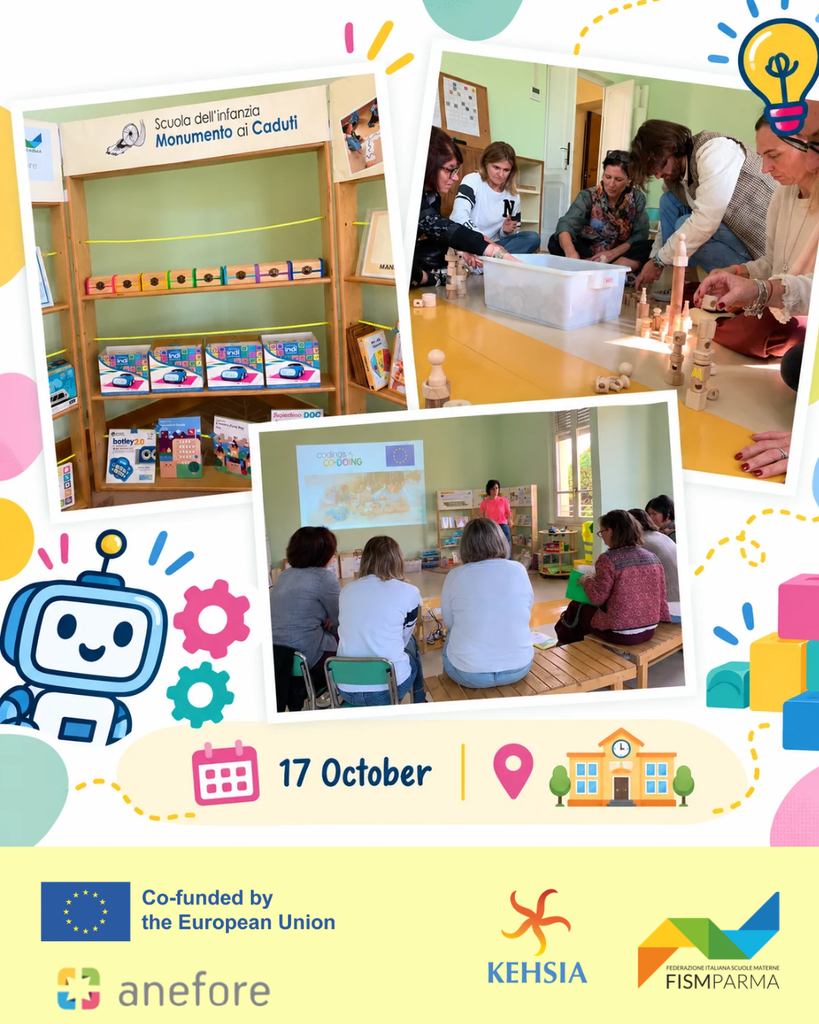
On 17 October 2026, Scuola dell’Infanzia “Monumento ai Caduti” in Parma hosted “CODING&Co-DOING. From Doing to Thinking: Coding Experiences in Early Childhood”, a training seminar organised by FISM Parma within the coding&CO-DoING project.
The event brought together teachers and educators to explore a central question: How can we introduce coding to children from 0 to 6 years old, and why is it valuable to start from early childhood?
The answer emerged through practice, experimentation and shared discovery.
Experiencing coding first-hand
During the seminar, participants explored unplugged coding and off-screen educational robotics through practical activities, concrete examples and hands-on workshops.
Teachers and educators had the opportunity to experiment directly with materials and educational resources, discovering how coding can be introduced without necessarily starting from a computer or a screen.
The activities showed how coding can become a playful and engaging educational tool to support the development of creativity, logical thinking, problem-solving and collaboration.
Learning by doing was at the heart of the experience. Participants were encouraged to explore, test different solutions, make connections and reflect together on how these activities could be transferred into their everyday educational practice.
When children become tutors
One of the most meaningful moments of the seminar was the direct involvement of the children as tutors.
The children became active protagonists of the learning experience, guiding teachers and educators through activities and helping them discover different strategies and ways of approaching coding.
This reversal of roles created a special opportunity for adults to observe learning from the children’s perspective. Through play, exploration, research and cooperation, the children demonstrated how curiosity and experimentation can naturally lead to new discoveries.
It was also a concrete example of the educational approach promoted by coding&CO-DoING: children are not simply recipients of knowledge, but active participants who can explore, collaborate, find solutions and share what they have learned.
A space for exploration and experimentation
The seminar also gave participants the opportunity to discover the Coding Lab – FISM Parma Research Centre at Scuola dell’Infanzia “Monumento ai Caduti”.
The space brings together different educational resources, materials for unplugged activities and tools for educational robotics, creating an environment in which teachers and children can explore coding through practical experiences.
Participants were able to discover and test these resources while reflecting together on how they could be integrated into activities for young children.
The experience highlighted an important message: teachers do not need to be coding experts to get started. Curiosity, experimentation and the willingness to learn together can be the starting point for introducing coding into early childhood education.
Officially recognised as an EU Code Week activity
We were especially pleased that the initiative was officially recognised as an EU Code Week activity.
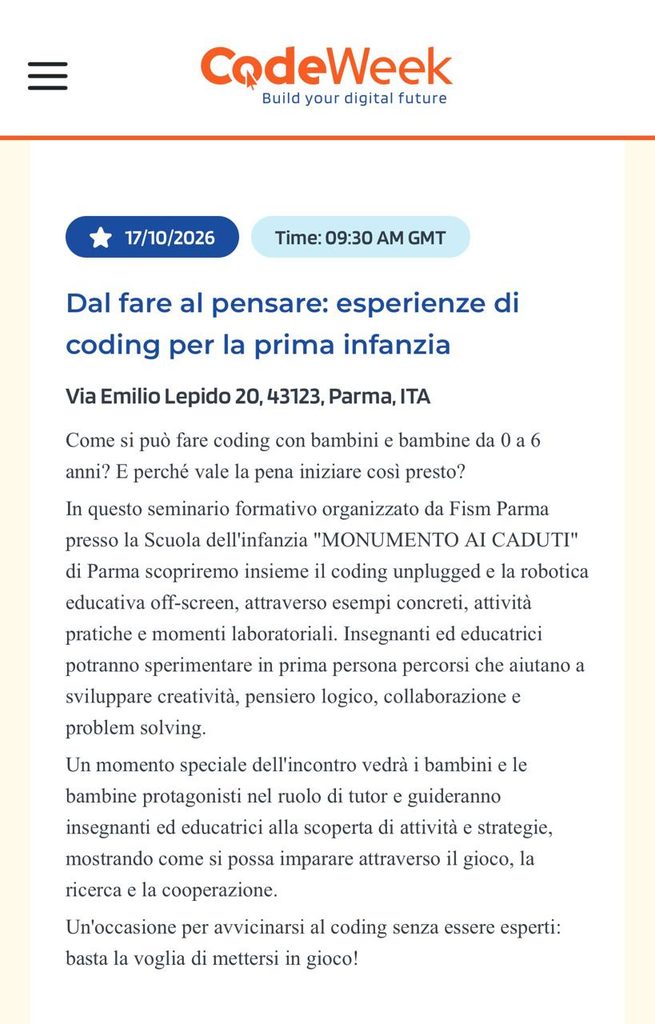
This recognition connected the experience developed in Parma with the wider European community promoting coding, computational thinking and innovative approaches to digital education.
For coding&CO-DoING, taking part in EU Code Week was an important opportunity to share a vision of coding that begins in early childhood and goes beyond the simple use of technology.
Through unplugged coding, educational robotics, hands-on activities, play and cooperation, coding can help children learn how to observe, think, explore different possibilities, solve problems, create and work together.
The event on 17 October was therefore much more than a training seminar. It became a space for exchange between teachers, educators and children, where different roles, experiences and perspectives came together around a shared approach to learning.
It also represented another important step for coding&CO-DoING: moving from ideas and training to concrete educational experiences and creating opportunities for teachers to experiment, reflect and learn from one another.
From doing to thinking, from playing to discovering, and from children to adults: coding becomes a shared journey of learning, creativity and cooperation.