
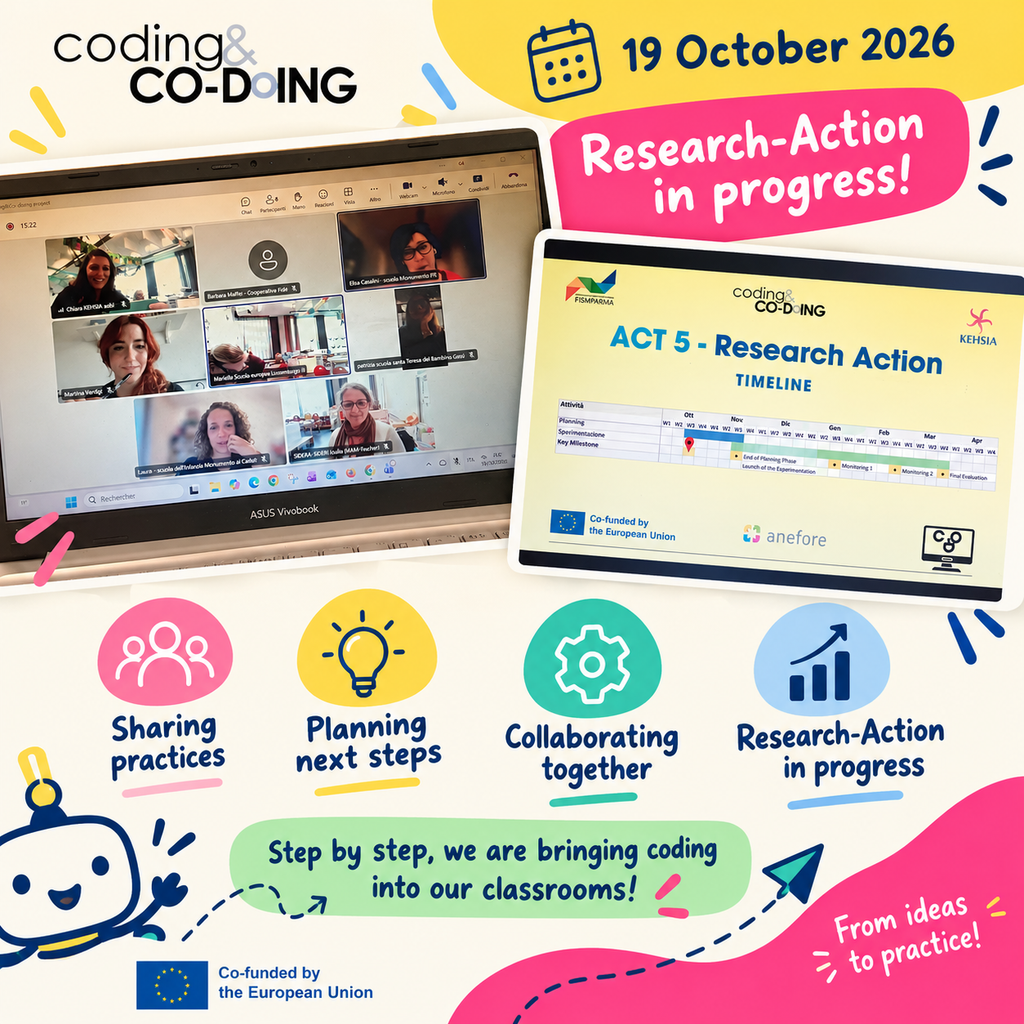
On 19 October 2026, the coding&CO-DoING team met online for another important moment of exchange, coordination and planning within the Research-Action phase of the project.
The meeting followed the peer-to-peer teacher training seminar held on 14 October and provided an opportunity to continue the work started during the previous session. Teachers and project partners came together to share practices, discuss the activities underway and define the next steps for the coming months.
The project is now moving from training and preparation towards experimentation in the classroom, putting into practice the methodologies, ideas and resources developed so far.
From planning to classroom experimentation
The Research-Action phase represents a central part of the journey. Its aim is to create the conditions for teachers to experiment directly with coding activities in their educational contexts, while observing, documenting and reflecting on the experience.
The project foresees Research-Action activities in the pilot schools and the development of guidelines based on the experience and data collected throughout the process, with the aim of supporting the integration of coding into educational practice.
During the online meeting on 19 October, participants reviewed the Research-Action timeline, discussed the planning phase and shared the next milestones. This collaborative approach is essential: rather than following a predefined model, teachers are actively involved in shaping the activities and adapting them to their classrooms and to the needs of their children.
The work carried out during these meetings will therefore support the next stage, when ideas and methodologies will increasingly become concrete learning experiences.
Coding as a tool for thinking and learning
At the heart of coding&CO-DoING is the idea that coding in early childhood education goes far beyond the use of technology.
Coding can offer children opportunities to observe, make predictions, understand cause-and-effect relationships, develop logical thinking and search for creative solutions. At the same time, cooperative activities can encourage children to work together, share tasks and learn from one another.
For this reason, the Research-Action will explore how coding and computational thinking can become part of everyday educational practice and support the development of critical thinking, creativity, problem-solving, collaboration and active learning.
The objective is to create experiences in which children are active participants in their learning, experimenting and discovering through play and direct experience.
Teachers at the heart of the process
The meeting on 19 October continued the collaborative work strengthened during the peer-to-peer training seminar on 14 October, when teachers shared knowledge and practices, explored the educational resources available through the project and began supporting one another in preparation for classroom experimentation.
This exchange between educators is itself an important outcome of coding&CO-DoING. One of the project’s ambitions is to ensure that the skills and methodologies developed do not remain limited to a small group. Instead, participating teachers can progressively become mentors and multipliers, sharing their experience with colleagues and helping new educational practices spread within the wider school community.
The 19 October meeting reinforced this approach, providing another space to discuss ideas, compare experiences and work together towards common objectives.
From ideas to practice
The Research-Action phase has now begun, and the next months will be an opportunity to see how the work developed through coding&CO-DoING takes shape in everyday educational contexts.
Teachers will continue to experiment, observe, exchange experiences and reflect together, gradually building a shared approach to coding in early childhood education.
This process is at the core of the project: learning from one another, testing new ideas and transforming individual experiences into shared knowledge.
The meeting on 19 October therefore represents another important step forward. From teacher training to classroom experimentation, coding&CO-DoING continues to build a community in which educators can collaborate, develop their skills and explore new ways of supporting children’s learning.
And during EU Code Week, this message becomes even stronger: coding can be a shared educational journey — one that begins with teachers working together and reaches children through creative, cooperative and inclusive learning experiences.