
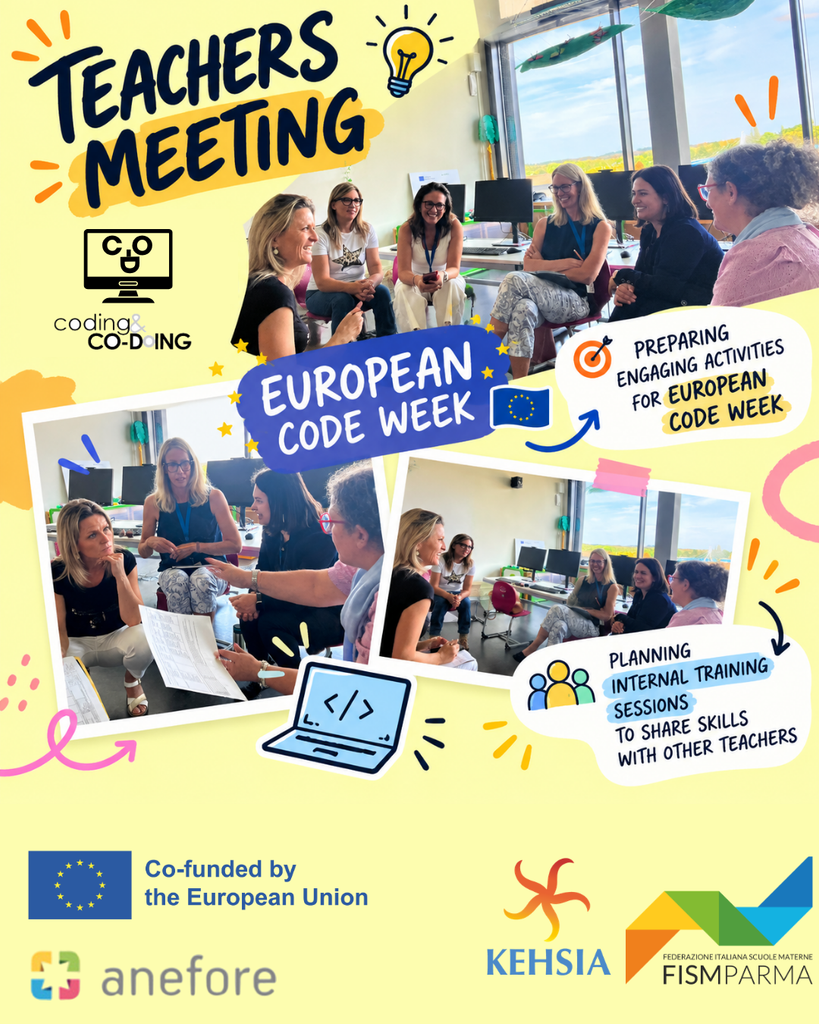
On Wednesday, 30 September, our teachers came together for a collaborative meeting dedicated to coding, creativity and shared learning, combining the preparation of activities for European Code Week with an important moment of exchange and professional development.
The meeting took place within coding&CO-DoING – Teaching coding in pre-schools in a cooperative and inclusive way, the Erasmus+ project that promotes the introduction of coding and computational thinking in early childhood education through innovative, cooperative and inclusive approaches. The project aims to make coding an integrated part of educational practice while strengthening teachers’ skills and creating suitable learning environments for young children.
Getting ready for European Code Week
One of the main objectives of the meeting was to prepare new activities for European Code Week, an opportunity to bring coding into the classroom in a playful and engaging way.
Teachers worked together to share ideas and develop activities adapted to young children, focusing not only on digital tools but also on experiences based on play, movement, observation, creativity and cooperation.
Within coding&CO-DoING, computational thinking is considered a valuable skill from the earliest years of education. Through coding activities, children can learn to recognise cause-and-effect relationships, make predictions, develop logical thinking and search for creative solutions to problems. At the same time, working together encourages collaboration, peer learning and the recognition of each child’s contribution to the group.
European Code Week therefore represents a valuable opportunity to put these principles into practice and to introduce children to computational thinking through experiences that are accessible, inclusive and fun.
Sharing skills within the school community
The meeting on 30 September was also dedicated to another important aspect of the project: sharing the knowledge acquired with other teachers.
The group began planning internal training sessions designed to transfer ideas, methodologies and practical experiences to colleagues. In this way, the skills developed through coding&CO-DoING can reach beyond the teachers directly involved in the project and become a resource for the wider educational community.
This multiplier effect is one of the key ideas behind the project. The aim is for participating teachers to gradually become mentors for their colleagues, supporting the introduction of new approaches and helping to spread good practices within their schools and educational networks.
Teacher collaboration is particularly important because introducing coding into early childhood education is not simply a matter of bringing new technology into the classroom. It also means reflecting on teaching methods, experimenting with new activities and finding creative ways to integrate computational thinking into children’s everyday learning experiences.
Learning, planning and growing together
The meeting was therefore an opportunity to plan, exchange experiences and learn from one another. Teachers are at the heart of coding&CO-DoING: they are not only learning new methodologies, but actively contributing to their development and adapting them to the needs of their classrooms.
Step by step, this collaborative work is helping to build a more creative and innovative approach to digital education, where technology becomes a tool for exploration, problem-solving, cooperation and inclusion.
The ideas developed during the meeting will now move into the next phase: from planning to practice, with activities for European Code Week and new opportunities for teachers to share what they have learned with their colleagues.