
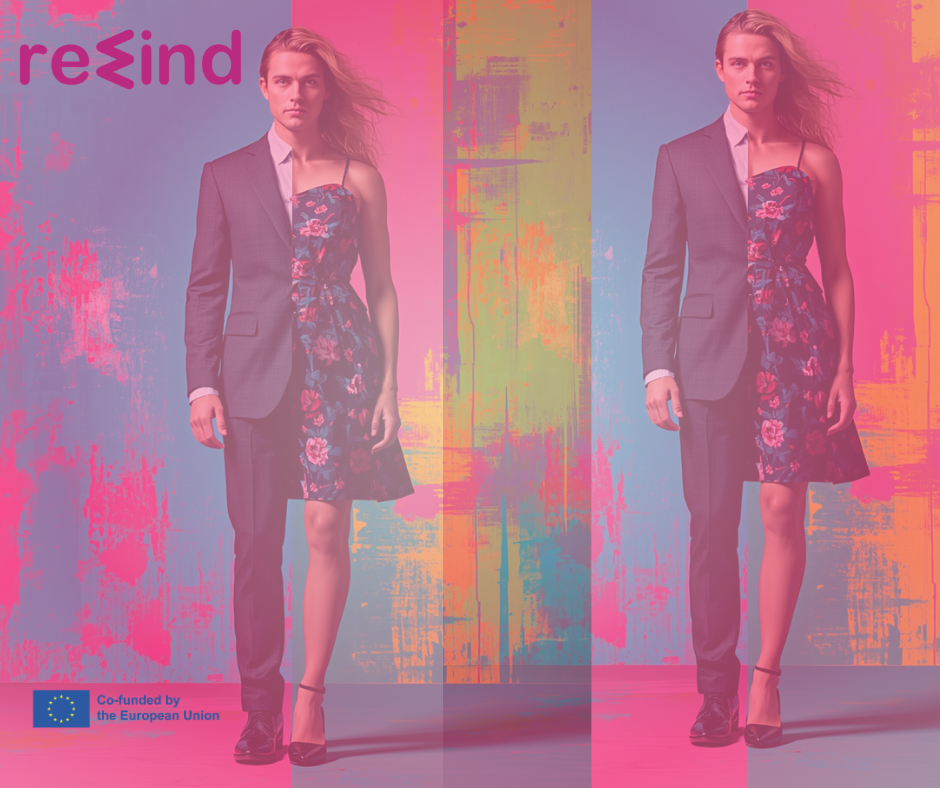
Have you ever stopped to wonder where our ideas about women and men actually come from?
Why are some careers still perceived as “more suitable” for men? Why do women continue to be underrepresented in leadership positions, in sports governance, in public monuments, or even in history books? Why do so many young people, despite believing in equality, still grow up surrounded by invisible expectations that shape their choices, ambitions, and identities?
The answer often lies in something we rarely notice because it has become part of everyday life: gender stereotypes.
Unlike discrimination, stereotypes are not always visible. They are woven into the stories we hear as children, the toys we receive, the films we watch, the advertisements we see, and the language we use every day. They tell us—sometimes subtly, sometimes explicitly—what women and men are expected to be. Girls are often encouraged to be caring, patient, and beautiful; boys are expected to be brave, competitive, and emotionally resilient. These expectations seem harmless when taken individually, yet together they create powerful social narratives that influence education, career paths, self-confidence, relationships, and participation in public life.
The most difficult aspect of stereotypes is that they often operate unconsciously. People rarely choose to believe them. Instead, they absorb them over years of exposure until they begin to feel like common sense. This is why simply presenting facts or statistics is rarely enough to change minds. Information can increase awareness, but lasting change requires something deeper: the ability to experience another perspective and question assumptions that have always felt natural.
This is precisely the space where RE.W.I.N.D. – Re Write in New Design Women Histories was born.
Rather than approaching gender equality through traditional lectures or awareness campaigns alone, RE.W.I.N.D. invites young people to become active participants in a process of discovery. The project recognizes that stereotypes are cultural constructions, and if they have been culturally created, they can also be culturally transformed. Its ambition is not only to identify gender bias but to help participants understand where it comes from, how it affects everyday life, and how each individual can contribute to changing the narrative.
At the heart of the project lies an innovative educational methodology: Educational Live Action Role Playing (EDU-LARP).
Unlike conventional learning environments, EDU-LARP places participants inside carefully designed fictional scenarios where they must make decisions, negotiate power, face prejudice, and interact with others while playing characters very different from themselves. There are no spectators. Everyone becomes part of the story.
This immersive experience changes the learning process completely.
Instead of reading about discrimination, participants may suddenly find themselves experiencing exclusion. Instead of discussing gender roles from a distance, they are challenged to navigate situations where stereotypes influence every interaction. They discover how easily assumptions can shape opportunities, relationships, and expectations. The emotional dimension of the experience encourages empathy, making abstract concepts personal and memorable.
Learning, in this context, becomes something lived rather than simply understood.
Yet RE.W.I.N.D. believes that reflection alone is not enough.
Every experience generated through the LARP becomes the starting point for a second creative journey. Participants are encouraged to transform what they have experienced into artistic expression through storytelling workshops, graphic novels, visual communication, illustration, and collaborative artistic production. The goal is not simply to document the project but to create entirely new ways of representing women and gender equality.
Art plays a unique role because it speaks where words often fail.
Images shape collective imagination. Stories influence how societies remember the past and imagine the future. If stereotypes have been built through generations of cultural representation, then art becomes one of the most powerful instruments for challenging them. Every illustration, every narrative, every creative work produced during RE.W.I.N.D. contributes to replacing limiting representations with images of diversity, empowerment, participation, and possibility.
In this sense, participants do not merely learn about gender equality—they become creators of a new cultural language.
The project builds upon the experience of the previous Erasmus+ initiative YOU ARE https://www.kehsia.eu/you-are/, which explored the underrepresentation of women in public spaces and highlighted how collective memory often overlooks women’s contributions to society. That earlier project revealed an important reality: even among young people who strongly support equality, unconscious stereotypes continue to influence perceptions and expectations. RE.W.I.N.D. takes the next step by transforming that awareness into action, offering participants practical tools to recognize these invisible mechanisms and actively reshape them through education, creativity, and civic engagement.
What makes RE.W.I.N.D. particularly meaningful is that it does not present young people as passive recipients of knowledge. Instead, it trusts them to become protagonists of change.
Throughout the project, participants are invited to collaborate, reflect, create, and share. They engage with local communities, contribute to artistic productions, participate in public events, and become ambassadors for a more inclusive vision of society. In doing so, they develop not only a greater understanding of gender equality but also skills in communication, teamwork, critical thinking, creativity, and active citizenship.
This approach reflects a simple but powerful belief: meaningful social change begins when people feel personally connected to an issue.
It is difficult to challenge stereotypes if they remain abstract concepts discussed only in classrooms or policy documents. It becomes much easier when people experience their consequences, recognize them within themselves, and discover that they have the ability to imagine alternatives.
The very name of the project—Re Write in New Design Women Histories—captures this philosophy beautifully.
It is an invitation to rewrite more than history itself.
It is an invitation to rewrite the stories we inherit, the images we consume, the symbols we celebrate, and the expectations we pass on to future generations.
It asks us to imagine a society where women’s achievements are not exceptional but visible; where leadership is not associated with gender; where creativity is free from predefined roles; and where every young person can choose their future without being limited by stereotypes inherited from the past.