
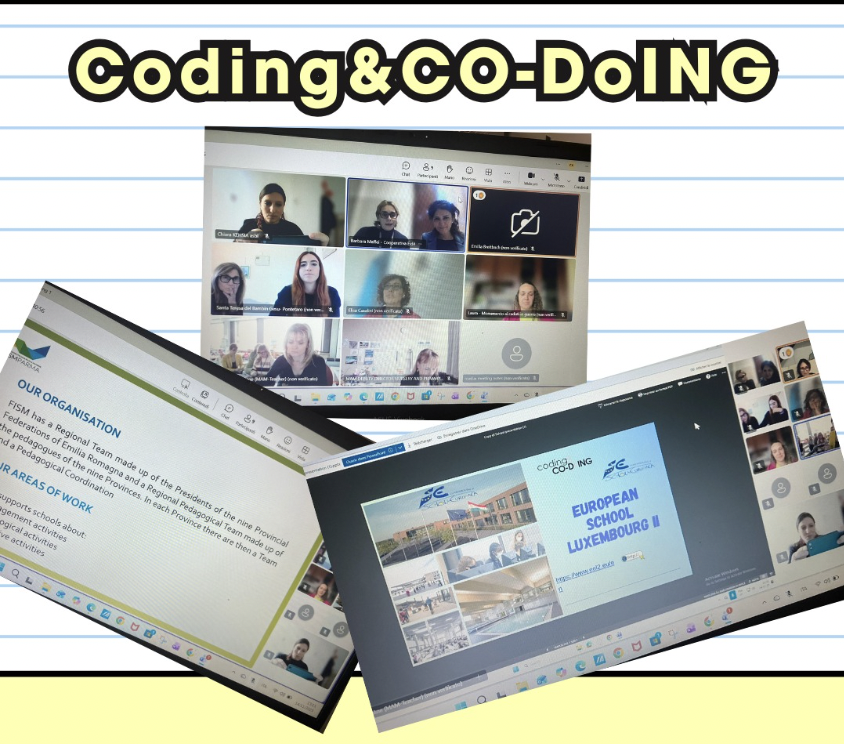
Before developing new methodologies, sharing practices and experimenting with coding in early childhood education, it is essential to understand where we are starting from. This was the main purpose of Action 2 – KEY MAPPING of the CODING&CO-DoING project: creating a shared picture of the educational contexts involved in the project, identifying existing experiences with coding and discovering similarities and differences between the participating schools. The Key Mapping activities brought together preschool teachers from two schools belonging to the FISM Parma network and the European School Luxembourg II, involved through project coordinator KEHSIA asbl. Between November and January, the participating teachers had the opportunity to meet, introduce their schools, share their educational contexts and begin reflecting together on the role of coding in early childhood education. More than a preliminary assessment, the mapping process became the first real space for dialogue and exchange between the Italian and Luxembourgish teachers, laying the foundations for the training and mobility activities that would follow.
November 14 – The beginning of a shared journey
The first training meeting for Action 2 – KEY MAPPING took place on November 14th and marked an important moment for the project: for the first time, the teachers involved from Italy and Luxembourg met each other and began discovering the different educational realities represented within CODING&CO-DoING. Teachers from the two preschool settings of the FISM Parma network and from the European School Luxembourg II introduced their school contexts, providing an initial overview of their educational environments, approaches and experiences. The meeting immediately highlighted one of the most valuable aspects of a European project: the opportunity to connect professionals coming from different countries, educational systems, cultural backgrounds and teaching traditions. Despite these differences, participants shared a strong enthusiasm for being part of an Erasmus+ experience and a common interest in exploring how coding can contribute to meaningful learning from the earliest years of education. The first meeting was therefore not simply an introduction. It represented the beginning of a professional dialogue in which differences could become resources for mutual learning.
Mapping before training
A central part of the first meeting was dedicated to presenting the initial assessment tool developed for the mapping process. The purpose of this tool was to better understand the starting situation of the participating schools and teachers before moving into the subsequent phases of the project. Mapping educational contexts is particularly important when working within an international partnership. Schools may use different terminology, follow different curricula, have access to different technological resources and already possess different levels of experience with coding and educational robotics. For this reason, before proposing a shared training pathway, CODING&CO-DoING created space to observe, listen and understand. The mapping process made it possible to identify existing practices and experiences while also encouraging teachers to reflect on their own approach to coding. During the November meeting, participants were also introduced to the main topics that would be explored in the upcoming training sessions. In this way, the mapping phase created a bridge between the schools’ existing practices and the new pedagogical perspectives that the project would later introduce.
January 16 – Luxembourg shares its experience
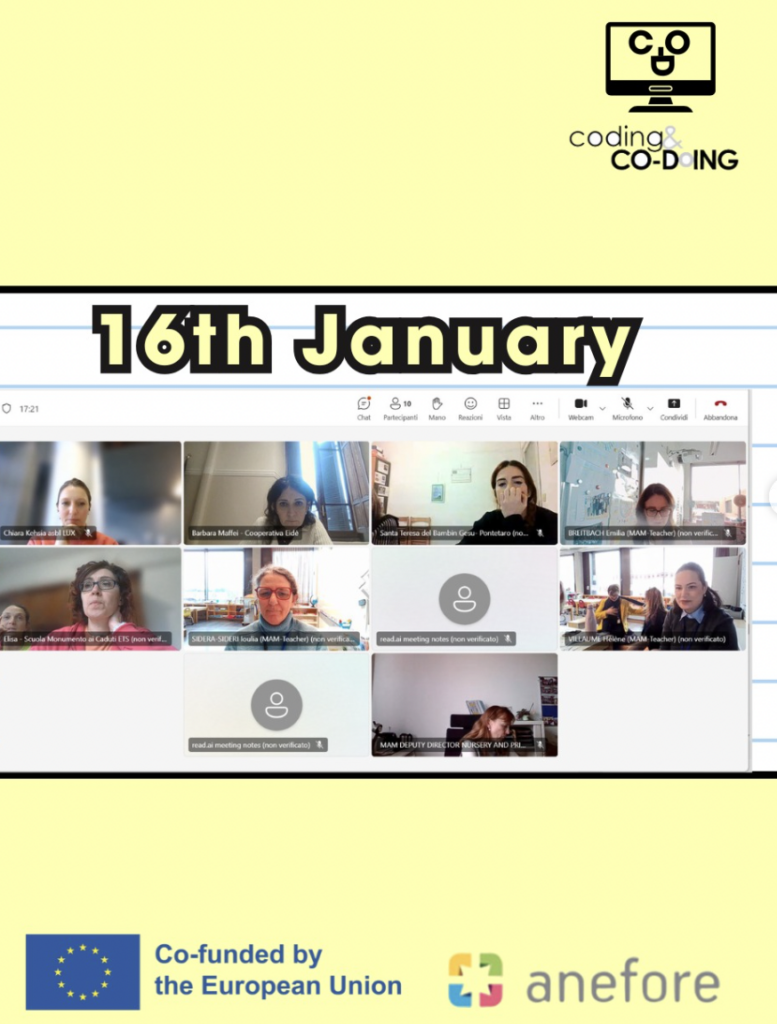
The Key Mapping journey continued on January 16th, when the focus moved to the European School Luxembourg II.
During this meeting, the Luxembourgish teachers presented their school context and showed how a wide range of coding activities are integrated into the curriculum as learning opportunities for children.
The European School Luxembourg II represents a particularly interesting environment for the project because of its multilingual and multicultural nature. Different language sections coexist within the same school, and children and teachers operate within different national and linguistic educational frameworks.
At first sight, this diversity might appear to make the development of shared practices more complex. Instead, the meeting demonstrated how coding can become a common educational language capable of connecting different sections and approaches. Sequences, instructions, spatial relationships, problem solving, logical thinking and experimentation can be explored beyond linguistic differences. Coding can therefore provide opportunities for children to participate through action, movement, visual information, collaboration and shared problem solving. This makes it particularly interesting within a multilingual educational context. The Luxembourg presentation also allowed the Italian teachers to discover concrete examples of how coding can already be embedded into everyday educational practice rather than being treated as an isolated technological activity.
Coding as common ground
One of the most significant reflections emerging from the Key Mapping process was precisely the idea of coding as common ground. The partner schools do not have identical contexts, and this is not the objective of the project. Each school brings its own identity, pedagogical traditions, resources, children, teachers and educational priorities. The value of European cooperation lies in recognising these differences while identifying areas in which experiences can be shared and new approaches can be developed together. Coding offers an interesting space for this exchange because it can take many different forms. It can be digital or unplugged. It can involve robots or the children’s own bodies. It can be connected to storytelling, movement, mathematics, spatial awareness, art or collaborative games. This flexibility allows each educational setting to interpret coding according to its own context while remaining part of a broader shared pedagogical reflection.
January 30 – Completing the school mapping
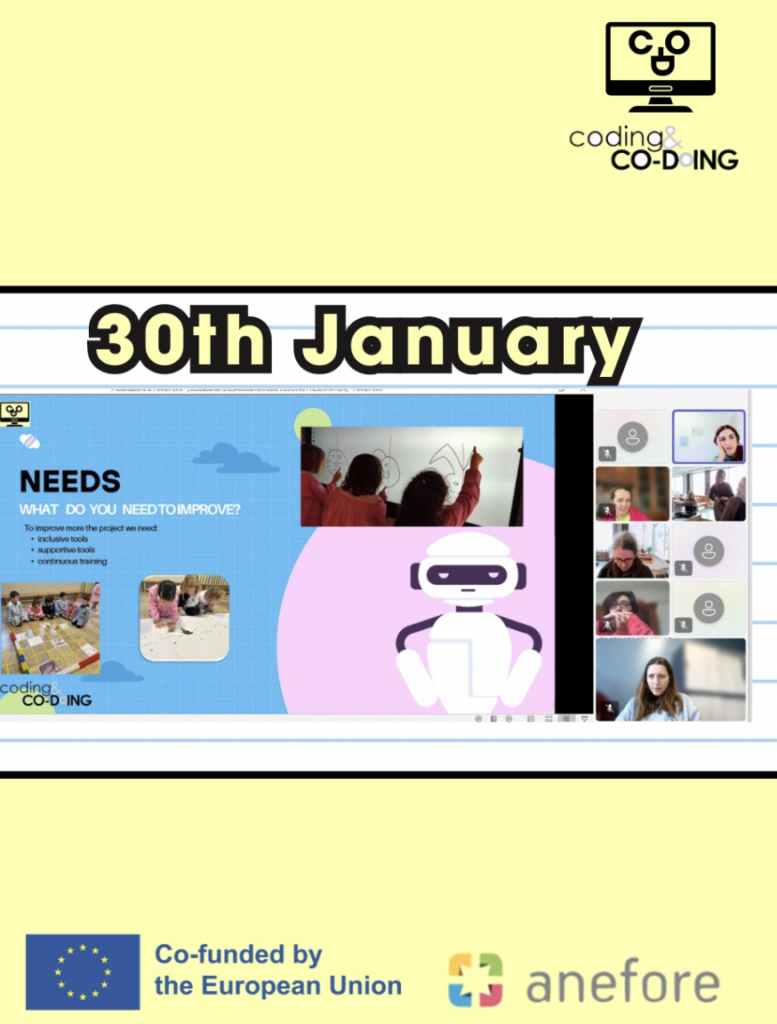
The final meeting of Action 2 – School Mapping took place on January 30th.
During this session, attention returned to Italy with the presentation of Scuola dell’Infanzia & Asilo Nido Santa Teresa del Bambin Gesù in Pontetaro, one of the preschool settings involved through FISM Parma.
The presentation provided another opportunity to discover the characteristics of one of the participating Italian educational environments and to continue comparing approaches, experiences and perspectives across the partner schools. With this final presentation, the mapping phase progressively brought together the different pieces of the CODING&CO-DoING educational landscape.
Each school contributed its own perspective, helping participants develop a richer understanding of the contexts in which the project’s future activities would take place. The objective was not to establish which school had the “best” approach to coding. Rather, the purpose was to understand what was already happening, what could be shared and where new possibilities for experimentation could emerge.
From mapping to training
The January 30th meeting also represented an important transition between two phases of the project. After completing the school mapping activities, participants were introduced to the agenda for the upcoming Action 3 teacher training, to be developed with the University of Bologna. This transition reflects the logic behind the CODING&CO-DoING pathway. Training does not begin in an abstract way. It starts from the real experiences, questions and educational environments of the teachers involved. The Key Mapping phase therefore created a foundation upon which the subsequent professional development activities could be built. By first understanding how coding was already perceived and implemented within the participating schools, the project could move towards a training process that encouraged teachers to critically explore coding, computational thinking, creativity, collaboration and educational design in greater depth.
From KEY MAPPING to CO-DOING
The completion of Action 2 marked the end of the first exploratory phase but, more importantly, opened the door to the next stages of the project. The schools had introduced themselves. Teachers had begun to know one another. Existing experiences with coding had started to emerge. Similarities and differences had become visible. The next step was to transform this knowledge into shared professional learning and experimentation. This is where the philosophy behind CODING&CO-DoING becomes especially relevant. Before “co-doing”, partners need to understand who they are working with. Before developing common activities, they need to recognise the contexts, experiences and perspectives that each participant brings to the project. The Key Mapping phase provided precisely this foundation. From the first meeting on November 14th to the final school mapping session on January 30th, Action 2 created a bridge between different schools, countries and educational cultures, preparing teachers for the training journey that would follow. The result was not a single definition of how coding should be taught in preschool education. Instead, it was the beginning of a shared European conversation about how coding can become creative, inclusive, collaborative and meaningful for young children. Different schools, different languages and different educational traditions – but a common starting point and a shared willingness to learn from one another. That is where the CODING&CO-DoING journey truly began.