
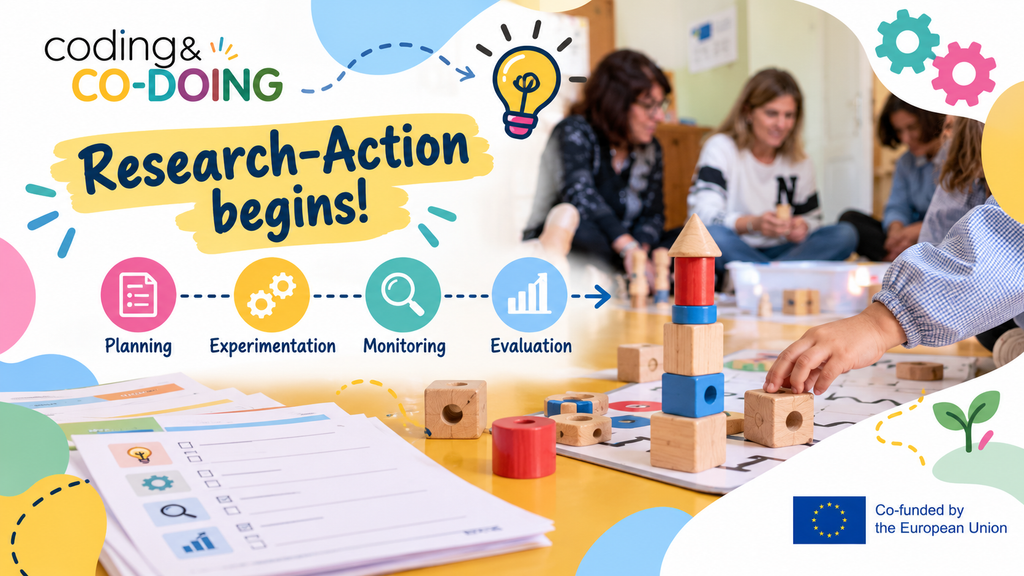
The second year of coding&CO-DoING has entered one of its most exciting and practical stages: the Research-Action phase.
After the training, exchanges and preparation carried out during the first part of the project, it is now time to bring ideas into practice. Over the coming months, teachers and children in the participating schools will be directly involved in experimenting with coding activities in early childhood education.
The aim is not simply to introduce new activities, but to observe, reflect and learn from what happens in the classroom, building shared knowledge from real educational experiences.
A common framework, different learning experiences
All participating schools will follow the same main stages of planning, monitoring and evaluation.
Having a common framework is important to ensure methodological consistency and to make it possible to compare experiences and results across the different schools. At the same time, Research-Action is not about making every school follow exactly the same path.
Each teaching team will develop its own educational proposal according to its specific context, choosing objectives and indicators that respond to the children involved, their needs and previous experiences, as well as the organisation of the school.
This balance between a shared methodology and flexibility is at the heart of the Research-Action process: everyone works within the same framework, while teachers remain free to adapt the experience to their own educational reality.
A toolkit to guide the journey
To support teachers throughout this process, the project has developed a dedicated Research-Action Toolkit: a practical set of shared tools designed to accompany schools from planning to observation and evaluation.
The toolkit includes a summary of the theoretical framework developed during the previous year together with the University of Bologna, a table of objectives and indicators, a planning template and a monitoring template.
These resources provide teachers with a common reference point while leaving space for experimentation, adaptation and professional reflection.
The table of objectives and indicators, for example, identifies six possible areas of development. For each area, teachers can choose between different objectives according to the characteristics and starting point of their group of children. The indicators then provide observable behaviours that can help teachers understand how children and groups are progressing.
Designing a journey, not a single activity
An important element of the Research-Action approach is the idea of continuity.
Teachers are not being asked to plan isolated coding sessions. Instead, they will design a sequence of connected experiences that can evolve over time.
The planning template has therefore been created to support an entire educational pathway rather than individual lessons. It is intended to be a flexible working document that teachers can revisit and adapt as the experience develops.
Observation and reflection will be equally important. Teachers will be able to record what happens during the activities, identify challenges, reflect on children’s responses and use these observations to shape the next steps.
In this way, planning, action, observation and reflection become part of the same learning process.
The next milestones
The first stage of the Research-Action is already underway.
From now until the end of November, the participating teams will focus on planning their educational pathways. Once this stage is completed, the experimentation with children will begin.
Several key milestones will accompany the process: the completion of the planning phase and the beginning of experimentation, a first monitoring moment at the end of January, a second one at the end of February, and the final evaluation at the end of March. The Research-Action phase is expected to be completed by 31 March.
These monitoring moments will allow schools to reflect on their experiences while also producing comparable information across the participating educational contexts.
Learning and reflecting together
Collaboration will remain a central part of the process.
Throughout the Research-Action, teachers will have opportunities to exchange experiences at different levels: within their educational teams, within their schools and, finally, as part of the wider European working group.
This exchange will help teachers learn from one another, discuss challenges and successful approaches, and gradually build a richer understanding of how coding can be integrated into early childhood education.
The most practical—and perhaps the most exciting—part of coding&CO-DoING is now beginning: bringing coding into preschools, experimenting together with children and turning classroom experiences into shared knowledge.
Over the next months, ideas will become activities, activities will generate observations, and observations will help us learn and improve.