
From inspiring conversations to new learning experiences, the past few months have been filled with opportunities to connect, share ideas and grow together.
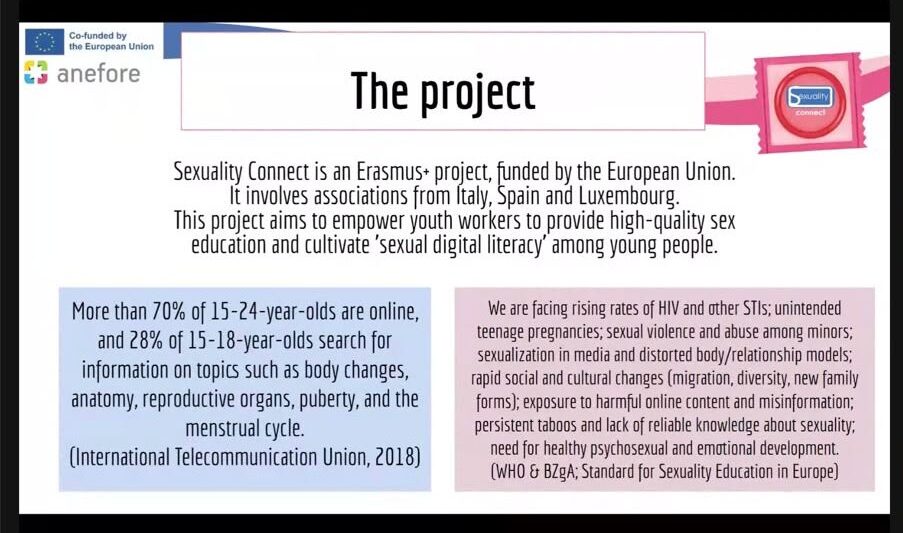
Among the many activities that kept us busy, the Sexuality Connect Erasmus+ project brought together youth workers from across Europe for a journey of learning, reflection and collaboration.
Let’s take a look back at what happened!
As part of the Sexuality Connect Erasmus+ project, thirteen online training sessions brought together youth workers from different European contexts to explore sexuality and relationship education, digital literacy, and online safety.
The programme addressed many of the issues that youth workers may encounter when supporting adolescents and young people. The sessions explored pleasure, consent and communication, gender identity, sexual and romantic orientations, relationships, body image, contraception, sexually transmitted infections, gender stereotypes, and gender based violence.
Particular attention was also given to the digital dimension of young people’s lives, including online identity, pornography, sexting and digital consent, grooming, online manipulation, and the non-consensual sharing of
intimate material.
Rather than approaching these topics exclusively through traditional lectures, the training was designed as an open and participatory learning experience. Each two-hour session combined theoretical input with practical activities, group discussions, reflective questions, and realistic scenarios inspired by situations that youth workers may face in their daily work with adolescents.
Participants were encouraged to question their own assumptions, exchange experiences, and contribute their professional knowledge. Shared Padlets became collaborative spaces where everyone could collect recommendations, good practices, books, podcasts, educational resources, organisations, and support services. In this way, the materials created throughout the programme were not simply delivered to the participants but developed together with them.
The training also encouraged a balanced understanding of digital environments. The internet was discussed not only in relation to risks and possible forms of violence, but also as a space for information, self-expression, community, belonging, and access to support.
The main objective of the programme was to develop practical and adaptable tools that youth workers could reuse in their activities with young people. At the same time, the sessions created an opportunity to strengthen a respectful, curious, and non-judgmental educational approach.
Sexuality Connect proved to be a valuable learning experience for both participants and trainers, showing
how knowledge, professional practices, and new resources can grow through dialogue and
collaboration.