
From professional learning to new opportunities for children and educational communities
CODING&CO-DoING Project
What happens when a teacher learns something new?
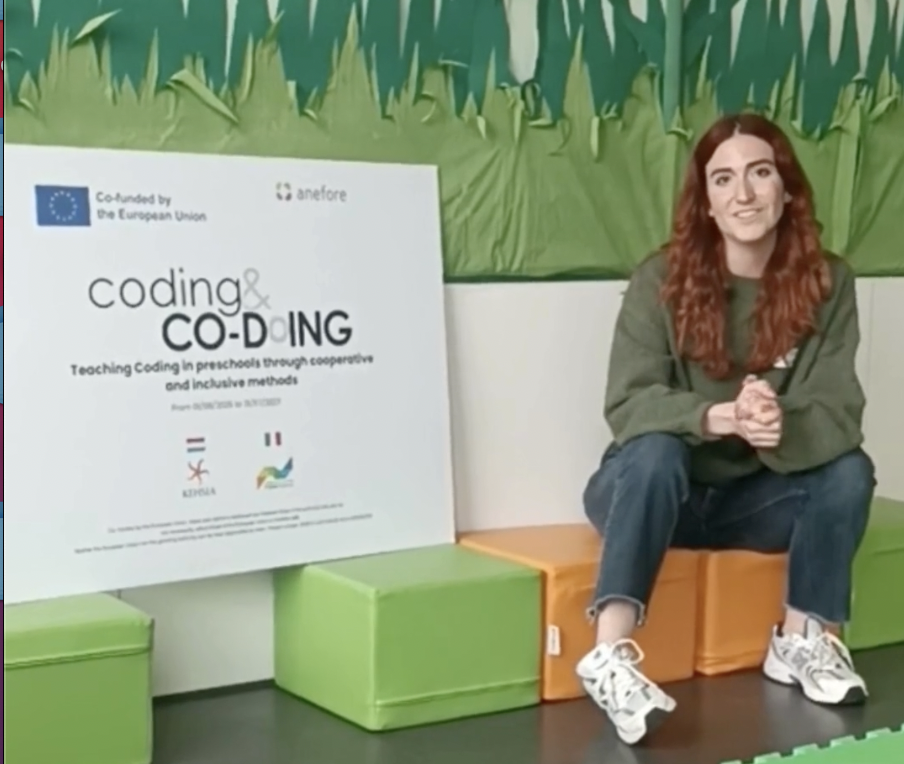
The impact rarely stops with one person. A new methodology, a different perspective or even a question discovered during a training experience can enter the classroom, influence the way children are supported and eventually become part of the practices shared within an entire educational community. This is one of the ideas at the heart of the CODING&CO-DoING project: teachers are not simply participants in professional development activities. They can become mentors and multipliers of good practices, transforming what they learn into new opportunities for children, colleagues and schools. The experience of Martina, a preschool teacher at Scuola dell’Infanzia Santa Teresa del Bambin Gesù in Ponte Taro, Italy, offers an interesting perspective on this process.
Through the project, Martina had the opportunity to reflect not only on coding as an educational methodology, but also on some fundamental questions about teaching itself: What happens when a child makes a mistake? How should the teacher respond? How much freedom should children have to develop their own ideas? Her reflections show how coding can become a starting point for a much broader conversation about education.
Coding: skills for school and for life
For Martina, the value of coding goes far beyond learning how to use a technological tool.
“Coding is important because it helps children develop specific skills not only for school, but for life. They can apply what they learn in many different areas.”
This is a fundamental aspect of introducing coding and computational thinking in early childhood education. When children engage in coding activities, they can learn to recognise sequences, understand cause and effect, break down a problem into smaller steps, make predictions, test ideas and reconsider their choices. However, these competences are not limited to a coding activity. The ability to approach a problem, imagine possible solutions, organise information and adapt a strategy when something does not work can be transferred to many different situations. Coding therefore becomes a learning environment for developing transversal skills. These are skills that children can gradually apply to different areas of learning and, more broadly, to everyday life.
Learning how to think, not what to think
The educational potential of coding becomes particularly interesting when children are not simply asked to reproduce a predetermined sequence. If every step is decided by the adult and there is only one possible answer, children may learn how to complete a task, but they have fewer opportunities to develop their own strategies. A different approach is possible. Teachers can provide a challenge, materials or a goal and allow children to explore how they might reach it. In this context, coding becomes an opportunity to learn how to think rather than what to think. Children can formulate hypotheses, test possibilities, change direction and discover that the same problem may sometimes be approached in different ways. For the teacher, however, creating this kind of environment requires something important: the willingness to leave space.
Rethinking error
One of the strongest reflections emerging from Martina’s experience within CODING&CO-DoING concerns precisely the meaning of error.
“This project has been very important for me because it made me reconsider what an error really is and the teacher’s attitude when a child makes a mistake.”
How an adult reacts to error can significantly influence the way a child experiences learning. If mistakes are immediately corrected, children may begin to look to the adult for confirmation before trusting their own ideas. But what happens if the teacher does not immediately provide the answer? What happens if the child is given time to observe, think and try again? Coding offers a particularly valuable environment for exploring this approach because feedback can often come directly from the experience itself. If a sequence does not produce the expected outcome or an educational robot follows a different path, something has happened that can be observed.
Rather than saying simply “this is wrong”, the teacher can ask: “What happened?” “Why do you think this happened?” “What could we try now?”
The mistake then becomes the beginning of another reasoning process.
The teacher’s posture
Martina’s reflection also introduces another important pedagogical concept: the posture of the teacher. Teaching is not only about choosing activities or educational tools. It is also about deciding when to intervene, when to ask a question, when to offer support and when to remain silent and allow children to continue exploring. Within an open coding activity, the teacher does not necessarily need to be the person who knows and communicates the correct solution. The teacher can become a mentor and facilitator, creating the conditions in which children can discover possible solutions themselves. This does not mean leaving children without guidance. On the contrary, it requires careful observation and intentional educational choices. The challenge is to provide enough support for children to continue learning without taking away the possibility of thinking independently. In this sense, the teacher’s role shifts from giving answers to creating opportunities for questions, exploration and discovery.
How much freedom can we give children?
Another important lesson Martina takes from the project concerns the space teachers give to children’s ideas.
“The project made me reflect on how much freedom, at the level of ideas, we can leave to children. I think this is very important if we want to build a more creative world.”
Freedom within an educational environment does not mean the absence of structure. Teachers still design the context, select materials and establish educational objectives. But within this framework, children can be given space to make choices, suggest alternatives and develop ideas that the adult may not have anticipated. This is particularly important for creativity. If children are always expected to reproduce the adult’s solution, there is little room for unexpected thinking. Creative learning instead requires the possibility of exploring a question for which the answer is not completely predetermined. Children need opportunities to say: “What if we tried it this way?” Coding can create these opportunities when activities are designed as open challenges rather than sequences to be copied.
Creativity begins with possibility
Building a more creative world begins by allowing children to experience the fact that there can be more than one way of thinking. This has implications far beyond coding. Creativity develops when children are encouraged to make connections, combine ideas, test unusual solutions and reconsider what they already know. Mistakes are inevitably part of this process. A classroom that values creativity therefore also needs to be a classroom in which uncertainty and experimentation have a place. The teacher plays a fundamental role in establishing this culture. By responding to unexpected ideas with curiosity rather than immediately evaluating them as right or wrong, educators communicate an important message: your thinking is worth exploring.
From teacher to mentor
This perspective helps redefine what it means for teachers to act as mentors. A mentor does not simply transfer knowledge. A mentor observes, accompanies, encourages and creates the conditions in which another person can develop their own competences and confidence. In early childhood education, this means recognising children as active participants in learning. Coding activities can become one of the environments in which this relationship is particularly visible. Children explore and teachers support. Children test ideas and teachers ask questions. Children encounter difficulties and teachers help them transform those difficulties into opportunities for further thinking. The objective is not to remove every obstacle from the child’s path. Sometimes the obstacle itself is where learning begins.
Teachers as multipliers
The concept of multiplication adds another dimension to this process. When teachers participate in European projects, training activities and international exchanges, the knowledge gained should not remain confined to the experience itself. It can return to the school. Teachers can experiment with new approaches in their classrooms, discuss them with colleagues, share activities and reflect together on the results. One teacher’s learning can therefore gradually become collective professional learning. This multiplier effect is particularly important for projects such as CODING&CO-DoING because sustainable innovation cannot depend exclusively on individual experiences. Good practices become more valuable when they circulate. An idea encountered during training can be adapted by a teacher. That teacher can introduce it to a group of children. The experience can then be shared with colleagues, reconsidered, modified and applied in another classroom. Through this process, innovation becomes part of the educational community rather than remaining an isolated project activity.
Multiplying questions as well as answers
Being a multiplier does not mean sharing only successful activities or ready-made methodologies. Sometimes the most valuable thing a teacher can bring back to colleagues is a new question. Martina’s reflections offer several examples: What is an error? How do we react when a child makes a mistake? Are we giving children enough time to find their own solutions? How much freedom do we allow them to express ideas that are different from our expectations? These questions can generate professional dialogue and encourage teachers to reconsider everyday practices. In this sense, European cooperation can have an impact even through apparently small changes. A different question asked during an activity, a few more seconds before intervening, or greater openness towards an unexpected solution can transform the child’s learning experience.
From good practices to a shared educational culture
The multiplier effect therefore involves more than reproducing an activity observed elsewhere. Every educational context is different, and good practices cannot simply be copied from one classroom to another. They need to be understood, adapted and reinterpreted. What can be shared are the pedagogical principles behind those practices: children’s autonomy, creative thinking, experimentation, collaboration and a constructive relationship with error. When these principles begin to circulate among teachers, they can contribute to building a shared educational culture. This is one of the long-term values of teacher professional development within European projects. Teachers return to their classrooms not simply with new tools, but with new perspectives through which they can reconsider familiar situations.
A more creative future starts in the classroom
Martina’s testimony ultimately connects coding with an ambitious but fundamental educational objective: helping children become capable of thinking creatively and independently. If we want future generations to approach complex situations with curiosity, flexibility and imagination, these attitudes need space to develop from childhood. Coding can contribute to this process, but the tool alone is not enough. What matters is the environment created around it. Children need teachers who allow them to explore. They need adults who do not immediately transform every mistake into a correction. They need opportunities to discover that an unexpected result can generate another question and that their own ideas can contribute to finding a solution. This is why teachers are essential mentors and multipliers of good practices. By learning, experimenting and sharing, they multiply not only educational methodologies but also a way of seeing children as capable, creative and active learners. And perhaps this is one of the most important outcomes of the CODING&CO-DoING journey: understanding that educational innovation begins not only with the tools we introduce into our classrooms, but with the space we create for children to think differently. Because giving children freedom to imagine new possibilities today can help them build a more creative world tomorrow.
CODING&CO-DoING is a KA210 project co-funded by Anefore through the Erasmus+ Programme. The project is coordinated by KEHSIA asbl (Luxembourg) together with FISM Provinciale di Parma – Federazione Italiana Scuole Materne, Provincia di Parma (Italy).