
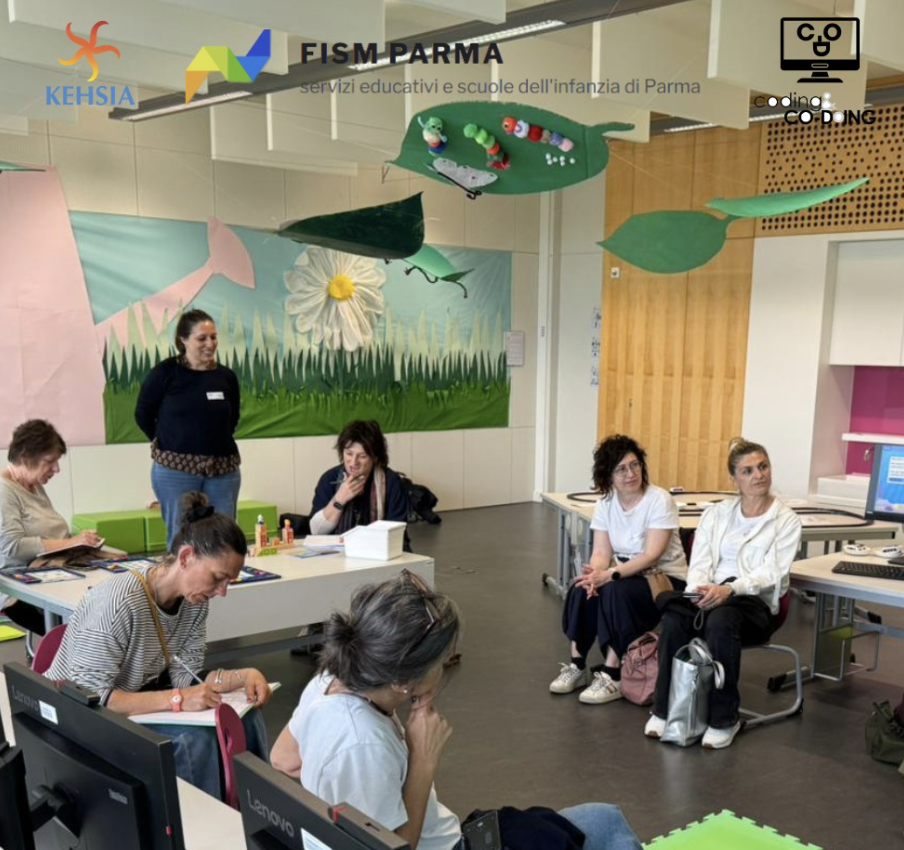
What does it mean to take part in a Job Shadowing experience? What skills can teachers gain by observing colleagues working in a different educational environment? And, most importantly, what new ideas, methods and perspectives can they bring back to their own classrooms? Within the CODING&CO-DoING project, Job Shadowing became much more than an opportunity to visit another school. It was a moment of professional and personal growth, allowing teachers to step outside their everyday educational context, observe different approaches, exchange experiences with international colleagues and rethink their own teaching practices. During the mobility experience in Luxembourg, Italian preschool teachers had the opportunity to enter a multicultural and multilingual educational environment, observe coding activities with young children, participate in practical workshops and experiment with educational methodologies based on coding, computational thinking, creativity and collaboration. But the real impact of such an experience is perhaps best understood through the voices of the teachers themselves.
Twenty years of teaching, and still something new to discover
Marialaura is a kindergarten teacher from Italy and has been teaching for twenty years.
Twenty years in education mean twenty years of experience, relationships, challenges, changes and learning alongside children. Yet one of the most powerful aspects of international mobility is precisely the possibility of discovering that, regardless of how much experience we have, there are always new perspectives to explore. For Marialaura, participating in a European Job Shadowing experience represented an opportunity to leave her familiar educational environment and encounter different ways of teaching and learning.
“This European experience was very exciting for me. It allowed me to open my mind and learn new things that I can bring back and do with the children in my school.”
Her words capture one of the fundamental values of Job Shadowing: learning through direct experience. Teachers do not simply attend a training session or listen to a theoretical explanation. They enter another educational context, observe colleagues at work, interact with children, ask questions and experience methodologies firsthand. This creates a bridge between theory and practice.
Opening the mind through European exchange
Teaching is strongly connected to context. Every school develops its own routines, methodologies, educational culture and ways of responding to children’s needs. Working in the same environment for many years naturally creates experience and confidence, but encountering another educational reality can provide something equally valuable: a different point of view. During the CODING&CO-DoING Job Shadowing experience, teachers from Italy encountered colleagues and children within the international environment of the European School Luxembourg II. Different languages, cultural backgrounds and educational traditions became part of the learning experience. Observing how another teacher introduces an activity, manages a group or encourages children to solve a problem can generate questions about one’s own practice. Why do I usually approach this activity in a certain way? Could there be another possibility? What would happen if I gave children more freedom to experiment? How could I adapt what I am observing to my own classroom? This is where Job Shadowing becomes more than observation. It becomes reflection.
Coding as a tool for thinking
One of the main areas explored during the mobility was coding in early childhood education. For Marialaura, the experience reinforced the idea that coding should not be understood simply as teaching children how to use technology.
“Coding is an extraordinary tool. It helps children develop creative and computational thinking – skills that will be useful for their future.”
Coding activities can encourage children to understand sequences, recognise cause-and-effect relationships, make predictions, solve problems and experiment with different possibilities. At preschool age, these experiences can take many forms. They can involve educational robots and technological tools, but also movement, colours, stories, spatial orientation and unplugged activities. The technology itself is therefore not the final objective. What matters is the thinking process behind the activity. When children need to decide how to reach a goal, give instructions, test a sequence or understand why something did not happen as expected, they are developing ways of reasoning that extend far beyond coding. At the same time, when activities are open to different possibilities, coding can become a space for creativity. Children are not simply following instructions: they can invent, test, modify and create.
From observing to doing
Another important dimension of Job Shadowing is the transition from observation to active experimentation. During the experience, teachers had the opportunity not only to observe educational practices but also to participate in hands-on activities and interact directly with children. This makes professional learning more concrete. A methodology that may initially appear abstract becomes easier to understand when teachers experience it themselves. They can observe children’s reactions, recognise potential difficulties and consider how the activity might need to be adapted to another group or context. For teachers, this also means accepting the same challenge that they often ask of children: trying something new without knowing exactly what will happen. And this is where one of the most important lessons of the Job Shadowing experience emerged.
Rethinking the meaning of error
Among all the activities, methodologies and tools explored during the mobility, Marialaura identifies one idea in particular that she wants to bring back to her school:
“The most important thing I will take home from this Job Shadowing experience is that an error is simply another way.”
This simple statement contains a powerful pedagogical message. In education, error is often associated with something that needs to be corrected. There is a correct answer and an incorrect one; a successful sequence and an unsuccessful one. Coding can help challenge this perspective. If a robot does not follow the expected path, for example, the child can observe what happened, reconsider the instructions and try a different solution. The mistake therefore becomes information. It tells us something about the reasoning process and creates an opportunity to think again. For young children, learning that an unsuccessful attempt is not the end of an activity can be particularly valuable. It can encourage curiosity, persistence, autonomy and confidence in exploring alternative solutions. Instead of asking only, “Is this right or wrong?”, children – and teachers – can begin asking:
“What happened? Why did it happen? What could we change? Is there another way?”
From this perspective, error becomes part of creativity and problem solving.
Teachers as lifelong learners
Marialaura’s twenty years of teaching experience make her reflection particularly meaningful. Professional development is not something that ends once a teacher has acquired experience. Education constantly evolves because children, societies, technologies and learning environments evolve. Teachers therefore remain learners throughout their professional lives. A European Job Shadowing experience creates a unique opportunity for this continuous learning because it combines observation, experimentation, intercultural exchange and professional reflection. It also reminds us that innovation does not necessarily mean replacing everything we already do. Sometimes innovation begins with a new question, a different perspective or a small change brought back into the classroom. A teacher may return home with a new activity, a new way of using an educational robot or a new approach to coding. But they may also return with something less visible and perhaps even more important: a different way of looking at how children learn.
Bringing the experience back to the classroom
The real value of mobility becomes visible when the experience travels back home with the teacher. The objective is not simply to reproduce exactly what was observed in another country. Every school has its own context, resources, curriculum and children. Instead, teachers can take the principles, ideas and inspiration gained during Job Shadowing and reinterpret them within their own educational environment. For Marialaura, this means bringing new coding experiences to her children, encouraging creative and computational thinking and creating more space for experimentation. Above all, it means bringing back a different understanding of the learning process itself. A child who makes a mistake is still thinking. A solution that does not work can become the beginning of another idea.
From Job Shadowing to shared European learning
This is ultimately what taking part in a Job Shadowing experience can mean: leaving your classroom for a few days and returning to it with new eyes. Through the CODING&CO-DoING project, teachers have the opportunity to engage with different educational settings and discover how colleagues from other countries approach teaching, coding, creativity, inclusion and children’s autonomy. These encounters enrich individual teaching practices, but they also contribute to something broader: the creation of a European community of educators willing to learn from one another. Marialaura’s experience shows that professional growth can happen at any point in a teacher’s career. Even after twenty years in the classroom, meeting different people, observing another educational system and experimenting with new methodologies can open unexpected possibilities. And perhaps the most important lesson to bring back to our classrooms is also one that applies to teachers themselves:
An error is simply another way of reasoning.
Learning begins when we remain curious enough to explore where that other way might lead.
CODING&CO-DoING is a KA210 project co-funded by Anefore through the Erasmus+ Programme. The project is coordinated by KEHSIA asbl (Luxembourg) together with FISM Provinciale di Parma – Federazione Italiana Scuole Materne, Provincia di Parma (Italy).