
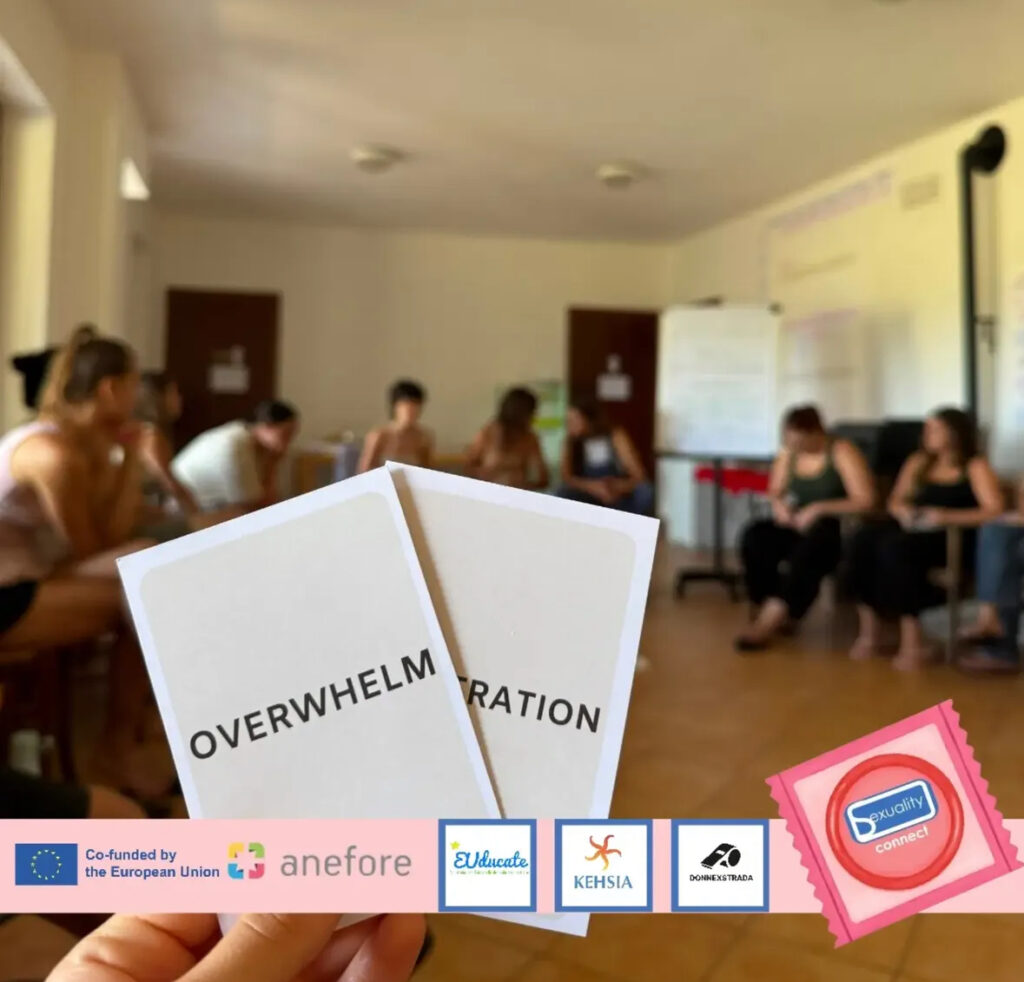
24 participants, 3 countries and 20 evaluation questionnaires: the ACT4 Mobility in Italy, held from 26 to 28 July 2026, was an important opportunity to learn, exchange experiences and strengthen the skills of youth workers involved in the SEXUALITY CONNECT project.
Bringing together participants from Italy, Spain and Luxembourg, the mobility created an international learning environment where youth workers could share experiences, explore new approaches and develop practical tools to address some of the key issues affecting young people today.
Through participatory activities, thematic working groups and practical exercises, ACT4 focused on consent, emotional intelligence, gender-based violence, digital spaces and online safety, with particular attention to the creation of safe and inclusive environments for young people.
At the end of the mobility, 20 participants completed an anonymous evaluation questionnaire, providing valuable insights into the learning outcomes, quality of the activities, international exchange and overall organisation of the experience.
What do the numbers tell us?
The evaluation shows a positive impact on participants’ perceived competences.
The strongest learning outcome concerned the ability to create safe and inclusive spaces for young people, with an average score of 3.85/5. Participants also reported improvements in their ability to support young people’s emotional intelligence (3.65/5) and to address consent (3.45/5).
The thematic working groups contributed to broadening participants’ perspectives on gender-based violence (3.45/5), while confidence in supporting young people to navigate digital spaces safely and critically received 3.35/5.
This last result, while still positive, also provides an important indication for future activities: digital safety is an area where additional practical tools and training could further strengthen youth workers’ confidence.
International exchange: one of ACT4’s strongest points
Beyond individual learning outcomes, the numbers highlight the importance of the international dimension of the mobility.
The exchange of experiences with youth workers from different backgrounds received 4.20/5, while group work was rated 4.00/5.
Participants particularly valued the opportunity to compare approaches and experiences from Italy, Spain and Luxembourg and to explore together topics such as consent, emotional intelligence, digital spaces, online safety and gender-based violence.
The qualitative feedback also highlighted the usefulness of practical tools and resources that participants can adapt and use directly in their activities with young people.
A learning environment based on inclusion and respect
One result stands out in particular: 4.55/5.
This was the score given to the trainers’ ability to create a respectful, inclusive and supportive environment, making it the highest-rated aspect of the ACT4 evaluation.
Participants also rated their feeling of being welcomed and at ease at 4.30/5, while the activities received 4.10/5 for their engagement and relevance to participants’ work.
These results show how the quality of a learning experience is not determined only by its content. When addressing sensitive topics such as sexuality, consent and gender-based violence, creating a space where participants feel comfortable sharing, questioning and learning is equally important.
Listening to participants
The evaluation also helped identify areas where future activities can be strengthened.
Several participants expressed a desire for more time for discussion, exchange and practical activities, particularly games and experiential exercises. Some suggested extending the duration of future mobilities, as the two-day training period left limited time to explore all the topics in greater depth.
Feedback also highlighted the importance of maintaining a balance between the different thematic areas, with a suggestion to dedicate more time specifically to sexuality-related topics alongside gender-based violence.
Participants also asked for clearer logistical information in advance, particularly concerning accommodation, exact addresses, transport and travel arrangements.
Despite these suggestions, the overall evaluation remained positive: accommodation, meals and logistics received 4.15/5, while the clarity and usefulness of information provided before and during the mobility scored 3.90/5.
From mobility to everyday youth work
Perhaps one of the most important numbers is 4.00/5: the score participants gave to the possibility of integrating the knowledge and methods acquired during ACT4 into their future work with young people.
This is where the impact of the mobility can continue beyond the three days spent together in Italy.
ACT4 was not only an opportunity to acquire knowledge, but also a space to exchange experiences, test approaches and collect tools that youth workers can bring back to their organisations and communities.
24 participants. 3 countries. 20 voices contributing to the evaluation.
Behind these numbers are experiences, exchanges and new skills that can be transferred into everyday youth work. The results of ACT4 confirm the value of creating international learning opportunities where professionals can develop more inclusive and informed approaches to consent, emotions, gender-based violence, sexuality and digital environments.
Through ACT4, SEXUALITY CONNECT continues its work towards a common goal: equipping youth workers with the knowledge, confidence and practical tools they need to create safer and more inclusive spaces for young people.